
 Facebook
 Linkedin
 WeChat
 YouTube
 Instagram
 Sitemap


MEDIA
News Room
Trade Heroes for Our Age. Bruce Kim, CEO of SurplusGLOBAL
- 2017-11-10


The King of used semiconductor equipment with 8 times of career changes
Demand for semiconductors has increased worldwide as the fourth industrial revolution comes near. Despite the era of fast-paced growth, the financial burden of a company on the machinery has also increased. That is the reason why there is a growing market for buying and selling used equipment among companies. SurplusGLOBAL is a leading player in this market. On October 12, I met Bruce Kim (51) at SurplusGLOBAL Headquarters in Osan, Gyeonggi-do.
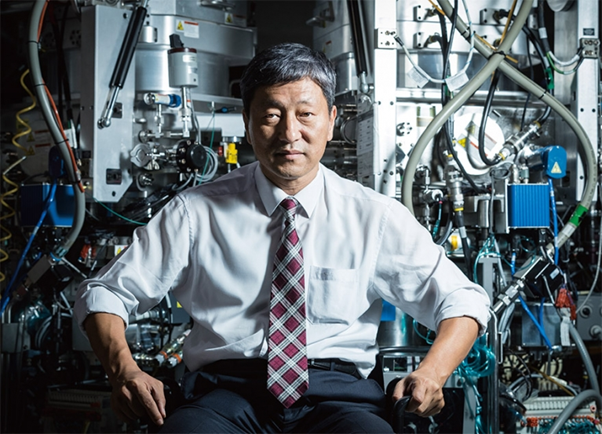
Over the past 17 years, SurplusGLOBAL has sold more than 20,000 used equipment to 40 countries around the world. It has ranked first with the largest market share in the worldwide used equipment trade market for five years.
The large warehouse in Osan, Gyeonggi Province in Korea was filled with mechanical equipment. I looked around the exhibition hall by riding on the electric kickboard. Hundreds of semiconductor machines are on display according to the category. The conditions of the products seemed to vary from almost brand new to a little bit old. SurplusGLOBAL has the world’s largest semiconductors used equipment exhibition center with a total area of 7,000 Pyeong of a constant temperature and humidity controlled showroom, and a 200 Pyeong clean room. Bruce Kim said, “An average of 20 buyers visit the warehouse every day and they are able to inspect 1,000 pieces of equipment directly, which is highly satisfactory.” He added, “Our new warehouse is under construction in Dongtan and its area is 20,000 Pyeong, which is 3 times larger than the current warehouse.”
Founded in 2000, SurplusGLOBAL is an used equipment distributor that sell used equipment after buying and storing it. SurplusGLOBAL handles used equipment of all items necessary for the electronics industry. Its major strategy is to buy cheaply in a recession and sell at a high price when it is booming.
One of the key competencies of SurplusGLOBAL is to set prices based on equipment specifications and customer needs. “We have been building a high-level database that analyzes decision making and sales experiences,” said Kim, who is proud of the “valuation ability” of used equipment.
Lessons learned from 8 times of career changes
SurplusGLOBAL boasts the supply and demand of equipment with a wide range of networks. The company, headquartered in Korea, with overseas subsidiaries in the US (San Jose/Phoenix), China (Shanghai) and Taiwan (Shinju), purchases used equipment from global top semiconductor companies such as Samsung Electronics, SK Hynix, Micron, Global Foundry and TSMC. Over the past 17 years, SurplusGLOBAL has sold more than 20,000 used equipment to 40 countries around the world. It has ranked first with the largest market share in the worldwide used equipment trade market for five years.
In the past, US and Japanese financial companies have occupied the distribution of used equipment as a lease agreement, and SurplusGLOBAL, a Korean company, has taken a strong position. Bruce smiled and said, “It was just good timing.”
8 times in 10 years. It is a number that Mr. Kim has changed his jobs from his first job at KOLON, to the establishment of SurplusGLOBAL in 2000. He used to work for various companies including foreign, large and small sized, as well as a public institution, from 2 years long to 3 months short. Mr. Kim said, “I frequently changed my jobs because I could not comply with the vertical organizational structure. I often got discouraged by lack of career experiences.”
So, there is no CEO office at SurplusGLOBAL. The employees’ work space is called ‘Decision Making Factory’ instead of the office. They do not call their Korean names with titles, but they call each other an English name. Meeting spaces like cafes were created in order to set up a culture with active discussion that goes ‘just before the fight.’ It is because Mr. Kim believes that hierarchical culture interferes with corporate growth. Despite moving the organization several times, Mr. Kim’s career experiences were all related to trade. In fact, he has built this kind of relationship with trade from his childhood.
“Give me Chocolate.” It was the first English learned by Mr. Kim, who was born in the village. Mr. Kim, who was born in the military camp town in Paju, Gyeonggi Province, and had been trading with US soldiers since the Korean War, thinks that his experience naturally led him to be a “trading man.” The first part-time job in junior high school was a disk jockey, and the second job was a ghostwriter of English letters for Western women. Mr. Kim added, “These experiences are also the reasons why I did not have any fear of foreigners.”
He entered the Department of Metallurgical Engineering at Yonsei University. In 1990, he joined KOLON Trading Co., while dreaming of a trading man who wears a trench coat and wanders around the US and Europe. However, the hierarchical organizational culture and daily life with full of documents were completely different from his dream. Most of all, he began to feel skeptical as the postal service was changed from telex to fax. He said, “The added value of brokerage in the trading companies has become ‘something anyone can do’.”
‘Let’s make new thing that combine the internet and trade.’ In 1995, the World Wide Web (www) was opened and the era of the Internet began. Mr. Kim frequently visited overseas websites and read the articles, and he even bought and read overseas books that were not published in Korea. The habit of purchasing more than 1,000 books a year is still filling up the office wall.
Patience and endurance
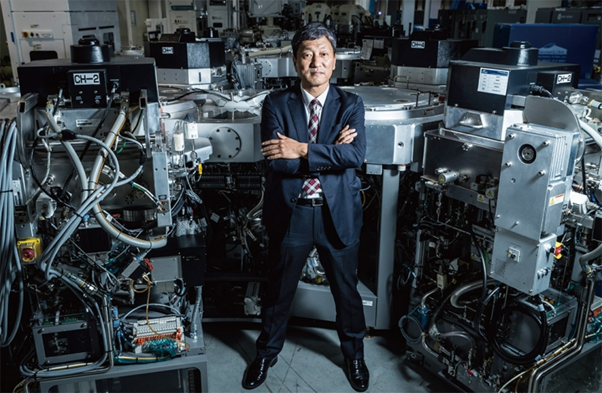
Mr. Kim said, “Equipment and materials-related businesses can be world-class if a company has accumulated technology for a long period of time. In Korea, it seems there are not many companies that are persistently pursing their goals with a technology roadmap of more than 10 years.”
In the late 1990s, Mr. Kim became an industry leader with the Internet craze. He predicted the growth of the e-commerce market through his numerate lectures and newspaper columns. He became popular among Internet experts.
In March 2000, he established SurplusGLOBAL. He raised investment of 2.3 billion won. It was also the time that he changed the business model to B2B e-commerce from online-market research that he had prepared for since 1994. Mr. Kim said, “At that time, Internet business companies such as Naver, Daum, Auction, Job Korea and so on were engaged in B2C model, which is a business-to-consumer transaction.” He added, “I have chosen B2B as a business model as the market size is a lot larger.”
The filed was also various. He bought and sold many items such as jeans, yarns and fabrics, machine tools, construction machines, buses, and pork. Mr. Kim said, “I went to the market in Majang-dong to buy meat and sold it back to Russia after seeing the newspaper article that the poultry stock was piling up due to foot-and-mouth disease in 2000.” He added, “I was called a ‘big hand in Majang-dong’ because I bought 200 to 300t of meat at one time.” At that time, he was certain that he would make his company as ‘eBay in the used market’ with a total value of trillion won in 3 years.
The result was terrible. It was not easy to deal with unspecified companies on the Internet. It was even harder to keep trust. For example, if some of the bearings do not arrive on time, the fab might have stopped. In the first year, 40 employees’ sales were only 280 million won. What is more, most of the deals were made in offline. The number of employees decreased to 6 within 2 years from its establishment.
As the company could almost go out of business in 2002, measures were required. Mr. Kim said, “At that time, a famous lime from the movie ‘The Gas Station Attack Incident’ came to mind which was ‘I target only one guy’ and I started to make a choice and concentrate.” He has gradually expanded business items from network equipment, SMT equipment, and measuring instruments which had low entry barriers and low initial investments. The company began to recover by selling dial-up idle equipment around the world. Fortunately, SurplusGLOBAL was specialized in global marketing compared to the competitors in Korea and overseas. Each employee focused on importing and exporting expensive equipment.
When the company almost achieved 30 billion on in sales in 2007, it had to suffer from the financial crisis in 2008. In the first quarter of 2009, quarterly sales which previously reached 10 billion won, decreased to 500 million won. It was 95% of sales that just disappeared within a few months. Financial institutions demanded repayment of borrowings and the company suffered from growing number of malicious stock. Mr. Kim recalls, “I felt like committing suicide for the first time.”
He endured hard times. He worked hard and waited until the company was on track. Mr. Kim’s patience has finally paid off. As the economy recovered in 2010, the environment of semiconductor industry improved rapidly. Mr. Kim said, “We made aggressive investment unlike other companies that were passive at that time,” and he emphasized, “In 2010, sales reached 50 billion won.”
Meaningful contribution for his son
In fact, thorough planning and preparation enabled him to wait patiently. Mr. Kim explained that as long as the short-term and long-term roadmaps are prepared, action would not a big problem. Mr. Kim said, “Equipment and materials-related businesses can be world-class if a company has accumulated technology for a long period of time. In Korea, it seems there are not many companies that are persistently pursing their goals with a technology roadmap of more than 10 years.” Over the last 10 years, the company’s average annual growth rate was more than 23%. It was listed on the KOSDAQ in January this year. Last year, sales exceeded 100 billion won.
Along with the growing business scale, he continues to make a social contribution. The establishment of the foundation ‘Smile Together’ in 2012 was like his long-standing task. He has been planning for this since his first son, who is 21 years old, has a developmental disability. Mr. Kim said, “Families of the developmentally disabled live under stress as if they are the soldiers on the battlefield. Creating a job for people with developmental disabilities is the best welfare that makes their families happy.”
SurplusGLOBAL is preparing for another leap. It will expand from semiconductor equipment distribution business to manufacturing sector. It is planning to provide one-stop solutions through equipment manufacturing, parts repair and development, as well as service. The reason why it merged with EQ Bestech, Inc., which is specialized in used equipment repair, is to diversify business and launch a new business.
He is also looking forward to favorable conditions in Chinese market. It is because demand for used equipment as well as new equipment is increasing due to the Chinese government’s policy to foster the semiconductor industry. Mr. Kim said, “Demand for used equipment will increase significantly in order for China, which lacks technical skills yet, to become a semiconductor powerhouse.” SurplusGLOBAL’s sales in Chinese market grew rapidly from 6.3 billion won in 2013 to 23.1 billion won last year. There is still a wide market in the industry to say that the business has reached the peak. It is the reason why Mr. Kim does not get exhausted even though he works 80 hours a week.
Resource :
